
TL;DR
Answer engines reply with a written answer and a few source links instead of ten blue links. They can only cite pages their crawlers can read, and they favor passages that answer the question outright. AEO work is answer-first copy, honest FAQ sections, business schema that matches your listings, open crawler access and, optionally, an llms.txt file. Google says its AI features need no special optimization beyond good SEO, so AEO is built on SEO, not instead of it.
AEO, GEO and AI SEO are three names for heavily overlapping work. If you want the side-by-side version, read AEO vs GEO vs SEO. If you want the research behind the GEO label, see what generative engine optimization is. This page sticks to answer engines: what they are, how they choose sources, and what to change on your site.
What Is an Answer Engine?
An answer engine is a search tool that replies with a written answer and a short list of sources, instead of a page of links. Google AI Overviews and AI Mode, ChatGPT search, Perplexity, Microsoft Copilot and Gemini all work this way. The person may never click, so being the named, linked source is the win.
The term is older than ChatGPT. Marketers first used "answer engine optimization" for featured snippets and voice assistants, where one answer gets read out and the rest of the page is ignored. Generative AI made the idea bigger: now the engine writes a fresh answer for every question and pulls passages from several pages to support it. Google's AI Overview is the version most of your customers see first.
How Do Answer Engines Pick Their Sources?
Answer engines search an index, pull the pages their crawlers are allowed to read, and quote the passages that answer the question most directly. So two things decide whether you get cited: whether the engine can reach and index your page at all, and whether a passage on it answers the question better than the other candidates.
The first part is documented by the engines themselves. Google says that to be shown as a supporting link in AI Overviews or AI Mode, a page must be indexed and eligible to appear in Search with a snippet, and that there are no additional technical requirements (Google, AI features and your website). Google also describes a "query fan-out" technique: the engine runs several related searches across subtopics to build one answer, which is why a page can be cited for a question it never targeted word for word.
| Answer engine | Where its sources come from | What keeps you out |
|---|---|---|
| Google AI Overviews and AI Mode | Google's search index, crawled by Googlebot | Not indexed, blocked in robots.txt, or a nosnippet / noindex rule |
| ChatGPT search | OAI-SearchBot, plus ChatGPT-User for pages a person asks it to open | Blocking OAI-SearchBot: OpenAI says those sites won't be shown in ChatGPT search answers |
| Perplexity | PerplexityBot, plus Perplexity-User for live lookups | Blocking PerplexityBot or its published IP ranges |
| Microsoft Copilot and Bing AI summaries | Bing's index, crawled by Bingbot | Not indexed in Bing, or blocked in robots.txt |
Sources: Google, OpenAI crawler docs, Perplexity crawler docs, Bing Webmaster Blog.
One detail trips up a lot of sites. OpenAI runs separate crawlers for search and for training: GPTBot collects content that may be used to train its models, while OAI-SearchBot decides what can appear in ChatGPT search (OpenAI, Overview of OpenAI crawlers). You can block training and still allow search. Blocking everything with an AI firewall rule blocks both.
The second part, which passage wins, is less documented. The best public evidence is the research paper that named GEO (Aggarwal et al., KDD 2024). In its test set, adding cited sources, quotations and statistics to a page raised how much of it showed up in AI answers by 30 to 40 percent, while keyword stuffing did little or nothing. That was a lab benchmark, not a promise, but it points the same way as Google's advice: clear, sourced, specific text beats keyword-heavy text.
Can AI crawlers read your site? Our free check tests robots.txt, server-rendered text, business schema, FAQ content and more in about a minute.
What Does AEO Work Look Like on a Real Site?
AEO work on a real site is five jobs: rewrite key pages so each question heading gets a direct answer first, add honest FAQ sections, publish business schema that matches your listings, make sure AI and search crawlers can read every page, and optionally add an llms.txt file. None of it is exotic. Most of it is good SEO done carefully.
| AEO task | What it fixes | Required? |
|---|---|---|
| Answer-first copy | Answers buried in the third paragraph, so no single passage is worth quoting | Yes, this is the core of AEO |
| FAQ sections | Real customer questions with no direct answer anywhere on the site | The visible Q&A, yes; the markup, no |
| Business and entity schema | Engines unsure of your name, services, area and contact details | No, but it removes guesswork |
| Crawlability | AI crawlers blocked by robots.txt, a firewall, or pages that only render in JavaScript | Yes, nothing else works without it |
| llms.txt | No plain-text map of your most useful pages for AI tools | No, optional |
Answer-first copy
Put the answer in the first one or two sentences under each heading, in 40 to 60 words, then explain. Phrase headings the way customers ask: "How much does gutter guard installation cost?" beats "Our Pricing Philosophy." Each answer should make sense if it is lifted out alone, because that is exactly what an answer engine does with it.
Compare two openings on a gutter company's page. Weak: "Every home is different, and many factors go into pricing." Strong: a price range for a typical house, what moves it up or down, and how to get an exact quote. The second version is the one a person wanted and the one an engine can quote. Use real numbers from your own jobs; never invent them.
FAQ sections and FAQ schema
Collect the questions customers actually ask on the phone and in Search Console, then answer each one in a short paragraph. That visible text is what matters. Google stopped showing FAQ rich results in Search on May 7, 2026 (Google Search Central updates), and says there is no special schema.org markup you need for its AI features.
We still add FAQPage markup to FAQ sections, because it labels each question and answer cleanly and costs nothing. Two rules apply: the markup must match the visible text word for word, which Google lists as a best practice for AI features, and it is never a reason to write questions nobody asks.
Business and entity schema
Answer engines have to know who you are before they recommend you. Organization or LocalBusiness markup states your name, services, service area, phone and profiles in a form machines read without guessing. It works best when it matches your Google Business Profile, Bing Places listing and directories exactly. Google's AI features guide tells site owners to keep Business Profile information up to date. Our schema markup glossary entry covers the basics.
Crawlability
Check three layers. Your robots.txt should allow Googlebot, Bingbot, OAI-SearchBot and PerplexityBot. Your CDN or firewall should not block them either; Google's guide names CDN and hosting rules alongside robots.txt. And the important text should be in the HTML the server sends, not loaded later by JavaScript, so every crawler sees it on the first request.
llms.txt
llms.txt is a proposed standard: a Markdown file at your site root that summarizes the business and links to your most useful pages (llmstxt.org). Google says you don't need AI text files to appear in its AI features, so treat it as a small extra, not a ranking lever. Our llms.txt guide shows how to write one in under an hour.
How Do You Measure Answer Engine Optimization?
No single dashboard shows AEO results, so measure four signals together: Search Console clicks on the pages you changed, Bing's AI citation report, referral visits from AI tools in Google Analytics, and a fixed list of customer questions you check in each AI tool every month. Then ask new leads how they found you.
| Signal | Where to find it | What it tells you |
|---|---|---|
| Google search clicks | Search Console, Performance report, Web search type | AI Overview and AI Mode traffic is included in the Web totals, not split out |
| AI citations in Copilot and Bing | Bing Webmaster Tools, AI Performance | How often your pages are cited, which URLs, and the grounding queries behind them |
| AI referral visits | Google Analytics 4, referral sources such as chatgpt.com and perplexity.ai | People who clicked through from an AI answer, and what they did next |
| Prompt checks | A fixed list of 10 to 30 customer questions, run monthly | Whether you are named or linked, and who is cited instead |
| Lead source | Your intake form or phone script | Customers who say an AI tool sent them |
Two of these come straight from the platforms. Google says sites shown in AI Overviews and AI Mode are counted in the Search Console Performance report under the Web search type (Google). Bing's AI Performance report, in public preview since February 2026, shows total citations across Copilot, Bing's AI summaries and select partners, with citation counts per page (Bing Webmaster Blog). It is the closest thing to a citation counter any engine offers today.
Start before you change anything, so you have a baseline. Our free AI visibility check covers the technical side in a minute. Our guide to getting cited by ChatGPT, Perplexity and Gemini goes deeper on the prompt list.
What Does AEO Look Like for a Service Business?
For a service business, AEO means answering the questions people ask before they call: what the job costs, how long it takes, which option fits their house, and whether you serve their town. Each answer belongs on a page built for it, with your real prices, photos and service area, and the same business details everywhere you are listed.
- A cost page per main service: a real range, what drives it, and how to get an exact quote.
- Service pages that answer "do you…?": what you do, what you don't, materials, timelines and warranty terms you actually offer.
- Town pages with substance: only where you have local jobs, photos and reviews to show, not copies with the town name swapped.
- A consistent profile: the same name, phone, services and area on your site, Google Business Profile, Bing Places and trade directories.
All of it sits on ordinary search visibility, because Google's AI answers draw on its search index. Our clearest example of that base is Sacramento Gutter Guard, a gutter company site we built and run. It had 60 organic Google clicks from Jul 27–Oct 18, 2025 and 776 over the same 12 weeks a year later (Jul 26–Oct 17, 2026).
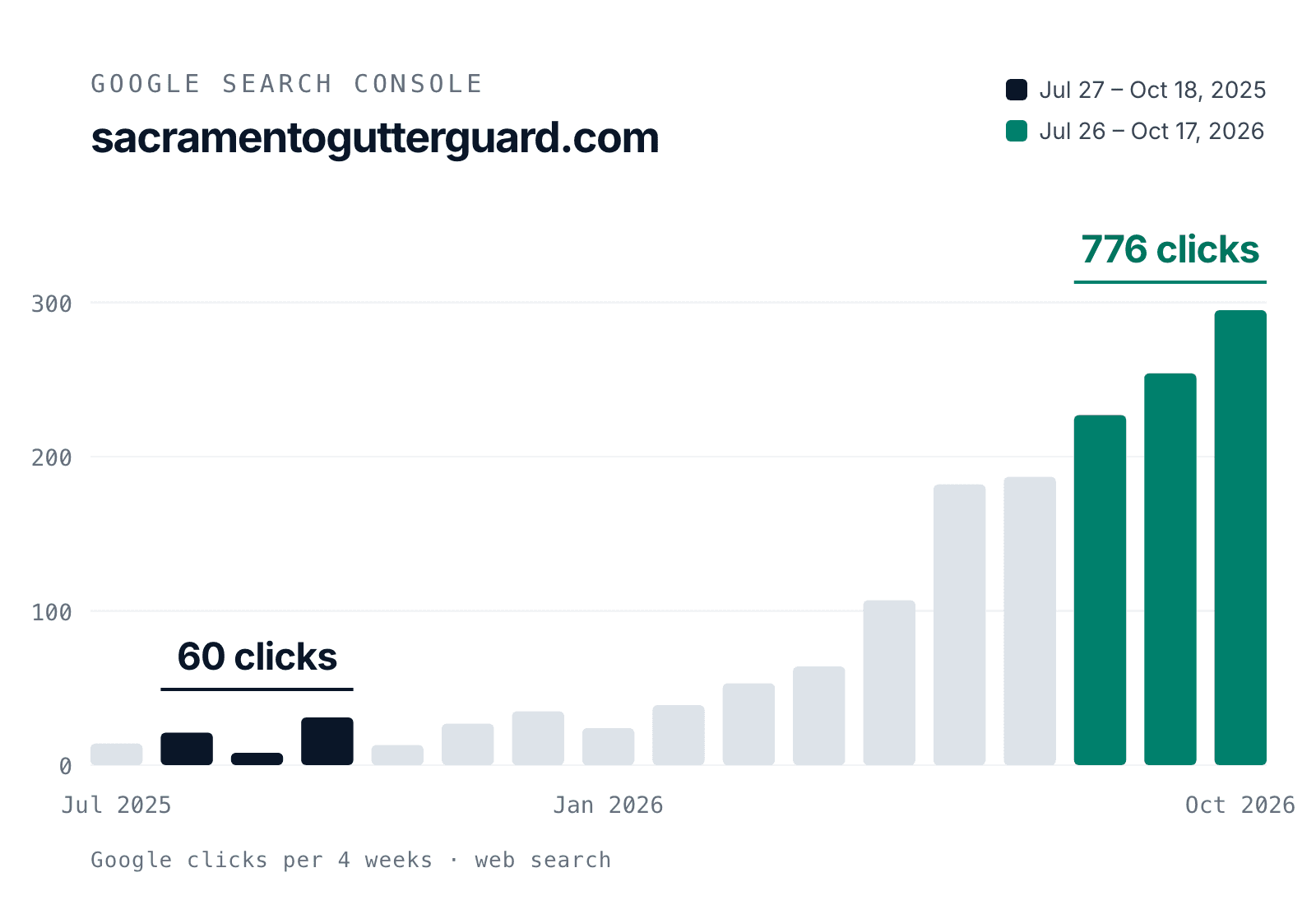
Those are Google search clicks, not AI citations, and one site in one market. The Sacramento Gutter Guard case study shows what we built. If you run a service business in Sacramento, Roseville, Rocklin or Folsom, our AI SEO services in Sacramento page covers how we handle this locally.
Is AEO Different From SEO?
Less than the name suggests. Google says the same SEO best practices apply to its AI features, with no extra requirements. AEO narrows the focus: the passage, not just the page, has to answer the question, and you also need ChatGPT and Perplexity crawlers allowed and a way to track AI referrals.
So don't buy AEO as a separate product from your SEO. Buy SEO that writes answer-first pages and reports on AI traffic. That is how our AI SEO services are set up, and what AI SEO costs breaks down the pricing. The full comparison is in AEO vs GEO vs SEO.
Frequently Asked Questions About AEO
What is answer engine optimization?
Answer engine optimization (AEO) is the work of making your website the source AI answer tools quote. You write direct answers to the questions customers ask, mark up your business details, and let AI crawlers read your pages, so ChatGPT, Perplexity and Google AI Overviews cite you.
Is AEO the same as GEO?
In practice, nearly. AEO is the older label, first used for featured snippets and voice assistants, and it stresses direct answers. GEO, named in a 2023 research paper, stresses generative AI tools. The work on your site is the same: crawlable pages, direct answers, consistent business details and mentions on trusted sites.
Do I need FAQ schema for answer engine optimization?
It isn’t required. Google says no special schema.org markup is needed to appear in its AI features, and it stopped showing FAQ rich results in May 2026. What matters is a visible question with a direct answer under it. If you add FAQPage markup, it has to match the text on the page.
Do I need an llms.txt file for AEO?
No. llms.txt is a proposed standard, and Google says you don’t need AI text files to appear in AI Overviews or AI Mode. It is cheap to add and can help AI tools find your best pages, so we include one, but crawler access and clear answers matter far more.
How long does answer engine optimization take?
It depends on where the page starts. Google builds AI Overviews from its own search index, so a page that is already indexed can be picked up after its next crawl. A new page has to be found and indexed first. Mentions on other sites take the longest. Nobody can give you a fixed date.
How much does AEO cost?
At Verlua it is part of the monthly SEO engagement, not a separate line item: $2,500/mo during launch months, then $1,500/mo for ongoing work. No minimum contract. Exact scope is confirmed after a free audit.
Want more customers from Google and AI search?
We start with a free audit of your site, crawler access and business listings in the Sacramento region. AI SEO is part of our monthly SEO: $2,500/mo for launch months, then $1,500/mo. No minimum contract.
Founder & Technical Director
Mark Shvaya runs Verlua, a web design and SEO studio in the Sacramento region. He builds and runs websites that bring service businesses more customers from Google and AI search.
California real estate broker, property manager, and founder of Verlua.
Stay Updated
Get the latest insights on web development, AI, and digital strategy delivered to your inbox.
No spam, unsubscribe anytime. We respect your privacy.
Related Articles
AEO vs GEO vs SEO: What’s the Difference?
A side-by-side table of goals, results, work and measurement, where the three overlap, and what to do first.
Read More about AEO vs GEO vs SEO: What’s the Difference?How Much Does AI SEO Cost? (2026 Pricing)
What AI SEO costs, what’s included, how it compares with regular SEO and how to measure results.
Read More about How Much Does AI SEO Cost? (2026 Pricing)Get Cited in AI Search: ChatGPT, Perplexity, Gemini
A step-by-step plan to earn citations in ChatGPT, Perplexity and Gemini answers.
Read More about Get Cited in AI Search: ChatGPT, Perplexity, Gemini